When Students Say, “Just Tell Me What to Do”
A colleague recently asked me a question about wrist position for her students, and our exchange stayed with me.
I told her that if we talk about the fingers to the elbow in a bidirectional way (lengthening in both directions), it can help the wrist to be an open channel. That openness helps us prevent tensing in that area.
After telling her this, she said “Adults tend to ask me exactly how high to hold the wrist, and I'm never happy with my answer.”
When I read that, I laughed a bit, because I can relate to students wanting a prescriptive answer. Just tell me what to do so I can do it!
My Alexander Technique practice has made me more comfortable with my answers—even though they’re often less satisfying to students who are looking for something definite. These days I work with the type of person who is not only open to uncertainty, but they know it’s often the place where real learning begins.
Yet I can see how it might be frustrating from the student’s perspective. Someone comes in with arm pain and I start talking about their hips and knees. What might they think about that?
I remember playing Dich, teure Halle for my AT teacher, Martha, and after all those notes and all that sound and all that effort (there’s a red flag), she said “Let’s talk about that little moment when you put on your glasses.” 🤭
Now that I’ve been practicing Alexander Technique for over seven years, I like these observations. I’ve learned that the things we don't expect (and aren’t paying attention to) are usually the things that are getting in our way the most.
So where might this show up in your playing and teaching?
When you’re struggling technically, have you noticed whether you’re adding extra weight by collapsing in on yourself? We tend to contract at difficult moments, when the better thing for us to do is expand. Maybe next time that happens, you could allow your hands and feet to send your head away. Take up more space and then play. Does that feel different? I explore this idea in the brief video below.
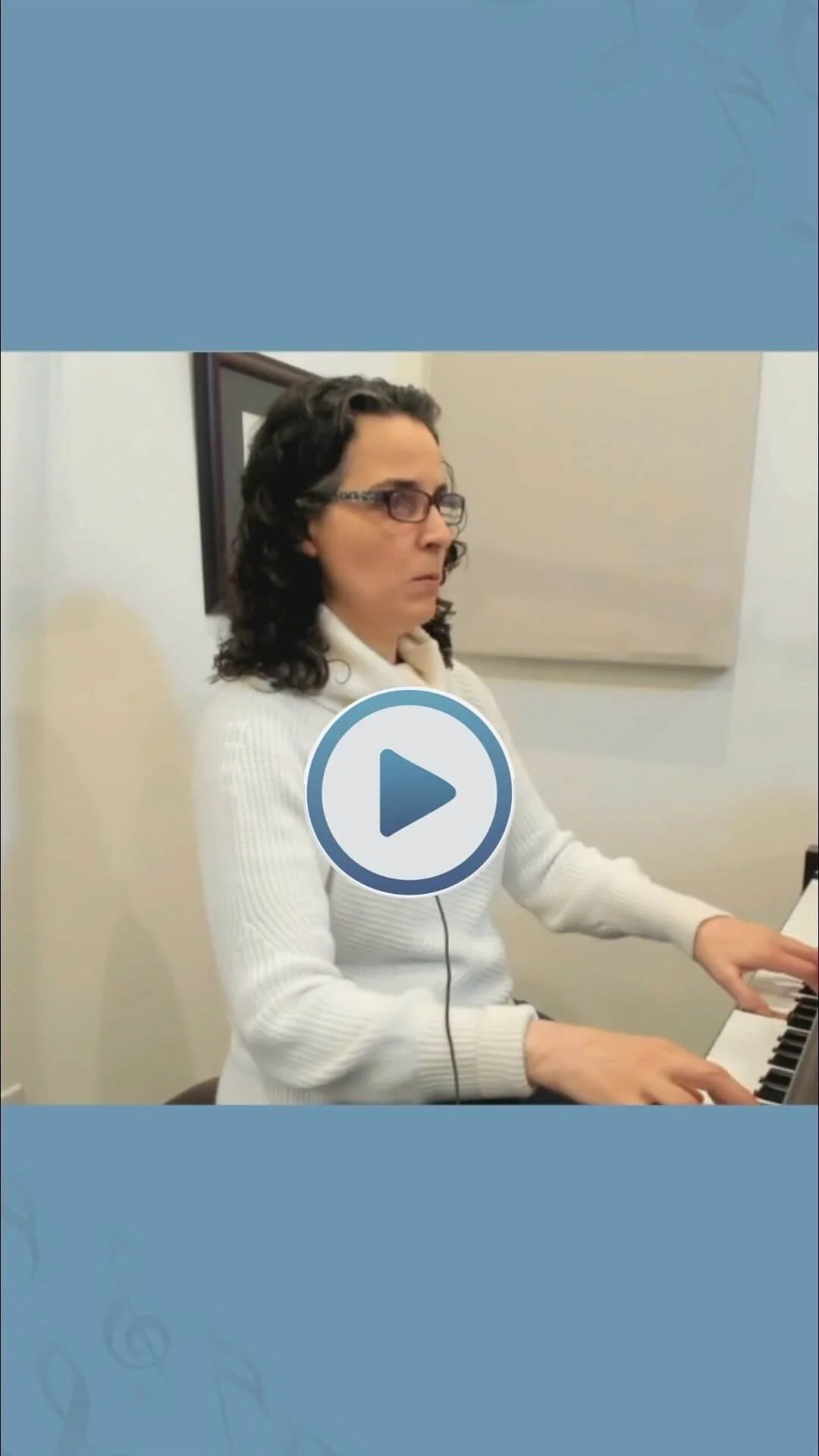
Try this when a passage feels difficult
Expansion is the opposite of what we tend to do in difficult moments, but it can really change how we play.
When you find yourself frustrated because you just can't get a student to keep their wrists where you’d like, have you noticed the way you’re approaching it? Should they “keep” or “hold” their wrists anywhere? Piano playing is about movement, not position. Perhaps instead you might notice the line from their fingers to their elbow. Maybe you can tell them it’s a double-ended light saber, freeing in both directions. Then see what happens with their wrist.
Teaching piano is such a creative act, and I find it to be even more so through an Alexander Technique lens. What used to be “just do it again,” “hold this here,” or “maintain that position” is now “how might I look at this differently?” or “how can I zoom out and see what’s really happening?”
I find it so much more enjoyable. It’s not certain or prescriptive—it’s an ever adapting practice. To me, that’s far more interesting than trying to find the “right” answer.
What do you think? Let me know your thoughts in the comments below, and if you’re a teacher who’d like to learn to use basic Alexander Technique concepts in your teaching, you can download my free pdf to get started.